The Skeldic Concord
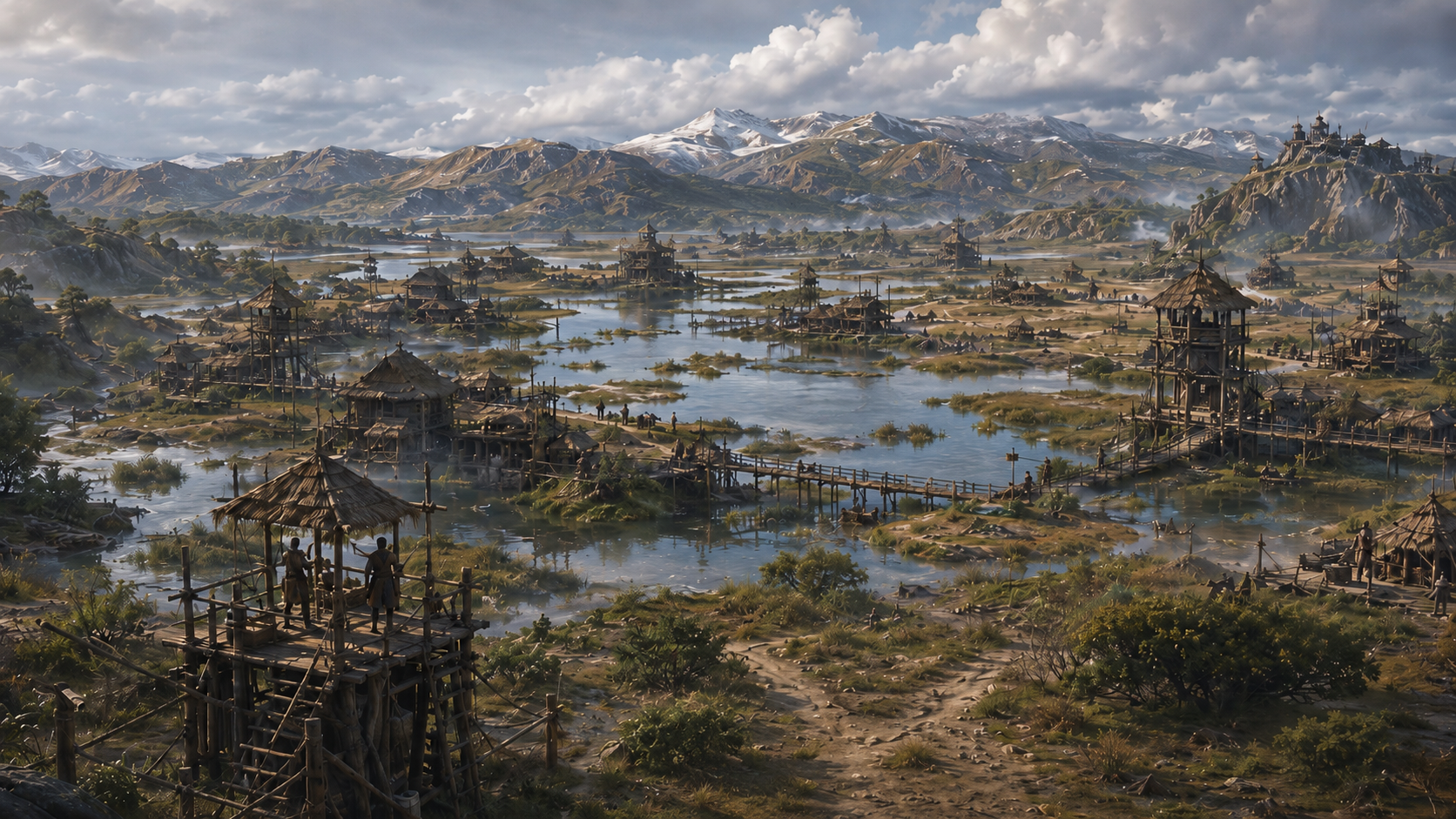
The Skeldic Concord is a human-led nomadic warrior society in the Floodlands of northern Arkhaven.
It is made up of roamers, drifters, exiles, oath-breakers, escaped serfs, displaced families, rejected soldiers, and outcasts from surrounding states who joined together for mutual defence and shared survival.
The Skeldic are not a kingdom and they do not organise themselves as tribes.
They are bound by concord-law: an agreement of protection, obligation, movement, and shared retaliation against those who threaten their people.
Government
The Skeldic Concord is governed through the Oathmoot, a formal assembly of sworn bands, caravan-houses, shield-companies, river camps, hill-settlements, and recognised freeholds.
Each recognised group sends an oath-speaker to the Oathmoot.
These oath-speakers do not rule as nobles. They carry the legal voice of the people they represent.
The highest authority is the Concord Marshal, elected during the Oathmoot and confirmed by public oath.
The Concord Marshal commands only in matters of defence, migration, border war, and retaliation.
Civil disputes remain with local oath-speakers, camp judges, and elder witnesses.
The Concord’s law is based on four central duties: defend the sworn, shelter the displaced, repay violence against the Concord, and never sell another Skeldic into bondage or foreign rule.
Dominant Peoples
Humans form the largest population of the Skeldic Concord.
Most are descended from frontier settlers, raiders, refugees, deserters, escaped labourers, and displaced families from older states.
The Concord also includes orcs, half-orcs, centaurs, minotaurs, aarakocra, firbolgs, kobolds, shifters, tieflings, and other peoples who survive well in hard frontier lands.
Race matters less than oath, usefulness, and loyalty to the sworn peace.
Region and Biome
The Skeldic Concord occupies the Floodlands, a vast arid and flood-prone region north of the Dornhal Empire and Republic of Havenor, east of The Vermillion Crown, and south of the Jhakur Clans.
It lies between dry open country, mountain ridges, river basins, and the southern edge of the northern jungle.
The land is mostly arid scrub, pale grassland, rocky basin, exposed hill country, and seasonal floodplain.
Water arrives violently rather than gently.
Dry ground becomes marsh after heavy rains, rivers overrun their banks, and low settlements are lost unless they are built high.
The Skeldic build upward rather than outward.
Homes are raised on stilts, set on hilltops, built into ridges, or stacked in narrow vertical towers.
Settlements are compact, defensive, and designed to survive flooding.
Roof-walks, rope bridges, ladders, raised granaries, and lookout platforms are common.
The Concord borders the Vermillion Crown to the west and south-west, the Dornhal Empire to the south, the Republic of Havenor to the east, and the Jhakur Clans across the sweeping north.
Mountain Ranges
The Skeldic Concord contains three major mountain systems.
The Frostgale Peaks
The Frostgale Peaks are the massive snowy mountains in the south of the Concord.
They are comparable to the Anvilspine Range, though smaller.
They form one of the strongest natural barriers between the Skeldic Concord and Dornhal.
Their upper slopes are glacial, storm-heavy, and difficult to cross.
The Cairnback Range
The Cairnback Range is the central mountain range of the Concord.
It cuts through the mid-region and divides flood routes, grazing paths, and caravan roads.
Hill-settlements, stilted watchposts, and old burial stones are common across its lower slopes.
The Northspear Range
The Northspear Range is the vertical mountain range running northward at the top of the Concord.
Its cliffs, narrow ridgelines, and high passes form a natural spine between the upper Floodlands and the lands approaching Jhakur territory.
Aarakocra roosts, signal fires, and highland oath-posts are concentrated here.
Lake Varkhuna
The great eastern lake is called Lake Varkhuna.
Lake Varkhuna is one of the largest bodies of freshwater in northern Arkhaven.
It lies on the eastern side of the Skeldic Concord and extends north into Jhakur land.
It provides fish, reeds, water routes, seasonal camps, and contested shoreline settlements.
The lake is dangerous.
Jungle-fed waters from the north carry monsters into its depths and reed-choked margins.
Lake Varkhuna contains large predators, scaled things from the jungle rivers, disease-bearing swarms, and creatures that attack boats, docks, and fishing platforms.
Skeldic lake settlements are built high on stilts or set back on raised ground.
Fishing is profitable, but it is never safe.
Godscar Access
The Skeldic Concord has severely limited access to the Godscar.
Many years ago, the Vermillion Crown took the rivers entering and exiting the western lake system connected to the Godscar.
This seizure secured the Vermillion Crown’s position in the continent and cost the Skeldic Concord important territory, water routes, and trade leverage.
The Skeldic lost ground during that expansion and never regained full control of the western river corridors.
The Concord remembers this as a defining humiliation and a major reason for its distrust of the Vermillion Crown.
Culture
Skeldic culture is mobile, martial, practical, and oath-bound.
Its people are roamers by necessity and warriors by habit.
They live by movement, seasonal routes, grazing rights, salvage, escort work, hunting, fishing, raiding, trading, and defensive alliances.
The Skeldic do not value polished nobility, inherited titles, or settled luxury.
They value endurance, reputation, courage, horsemanship, weapon skill, water knowledge, flood survival, and loyalty under pressure.
Hospitality is law, but it is not soft.
A stranger is fed and questioned. A guest is protected while under roof-oath. A thief is marked. A traitor is cast out. A slaver is killed.
The Concord has no single capital.
Its political centre moves with the Oathmoot.
Great gatherings are held on high ground, usually among fortified hill camps, central ridges, or flood-safe assembly fields.
Common Skeldic structures include stilt-houses, hill towers, vertical halls, raised barns, ladder forts, caravan circles, flood platforms, reed-roofed watchhouses, and cliff-perched storehouses.
Religion and Magic
The Skeldic Concord worships many gods.
Its people honour war gods, storm gods, road gods, river spirits, ancestors, hearth guardians, beast powers, and gods of survival, endurance, and vengeance.
Faith is decentralised.
Each sworn band, caravan-house, shield-company, and settlement keeps its own shrines and rites.
Oath-taking is the most important shared religious act across the Concord.
Magic is present but uneven.
The Skeldic use practical magic for weather signs, flood warnings, healing, warding, beast-handling, tracking, river crossing, monster defence, and preserving food during long movement.
Battle-magic exists among war-priests, hedge-mages, storm-callers, and exiled spellcasters from other states.
The Concord does not maintain grand magical schools.
Magical knowledge is passed through oath-teachers, travelling masters, family lines, camp priests, and battlefield experience.
Tensions
The main external tension is with the Vermillion Crown.
The Crown’s seizure of the western river corridors cut the Skeldic off from stronger Godscar access and reduced their control over lake and river movement.
This loss remains one of the central political wounds of the Concord.
The second tension is environmental.
The Floodlands are dry for much of the year but flood violently when the rivers rise.
Homes, roads, herds, and stores must be built around this cycle.
Poorly placed settlements do not survive.
The third tension is the northern jungle frontier.
Lake Varkhuna extends into Jhakur land, and monsters from the jungle enter the lake and its river systems.
Fishing villages, reed camps, and northern shoreline routes are regularly threatened.
🡐 States of Arkhaven