Dornhal Empire
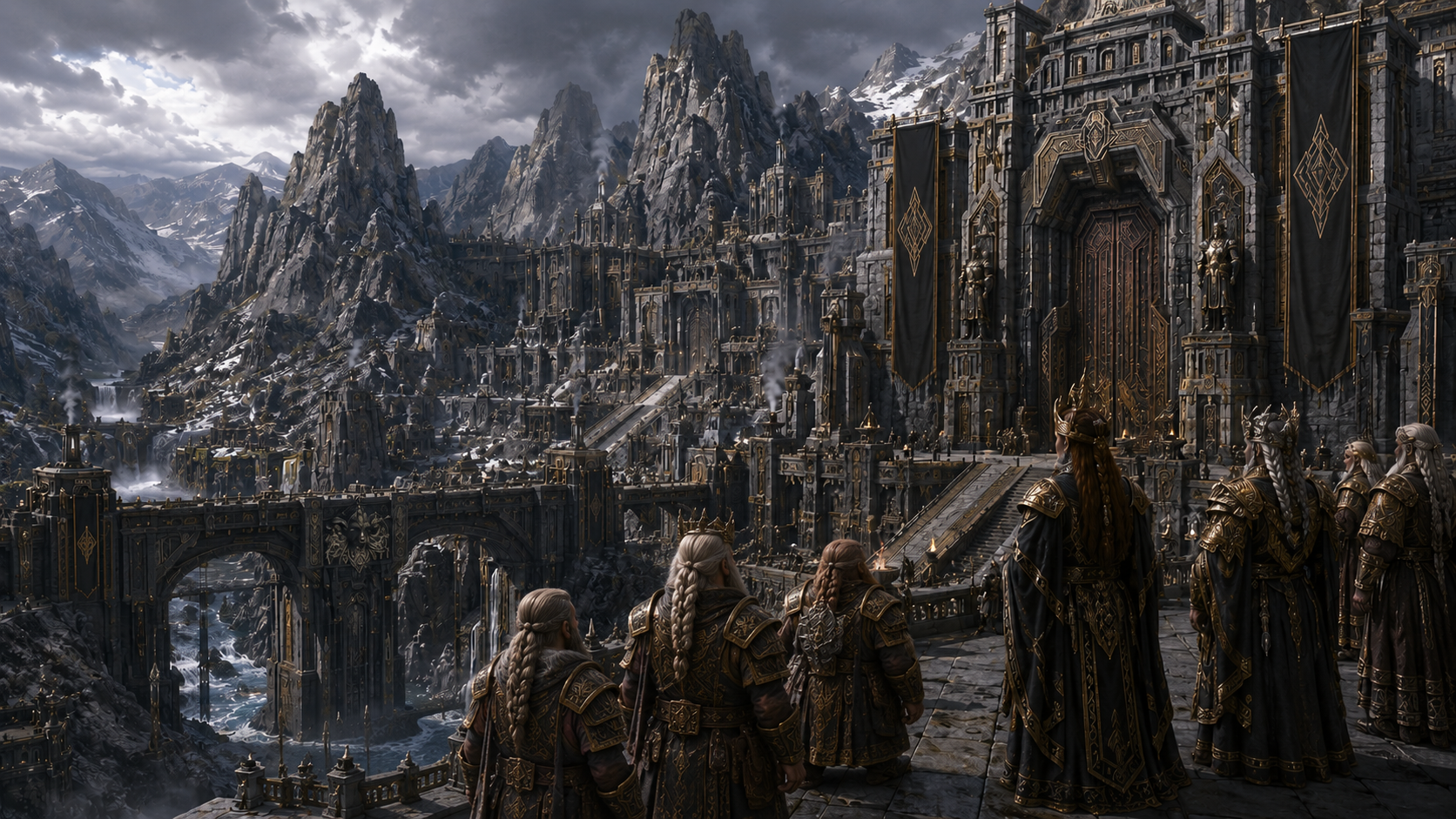
The Dornhal Empire is a dwarven imperial state descended from Khuldovar but culturally and politically distinct from it.
It is ruled by a queen and an all-female council, with a society shaped by central authority, hard mountain frontiers, imperial law, and practical ambition.
Dornhal split from Khuldovar many centuries ago.
The separation created a rival dwarven tradition: Khuldovar remained ancestral, conservative, and clan-focused, while Dornhal became more centralised, adaptive, and imperial.
Government
Dornhal is ruled by Queen Marzanna Duskhammer, daughter of the late King Ormund Duskhammer.
Queen Marzanna took the throne after her father’s passing and rules as the sovereign empress of Dornhal.
Her authority is supported by the Matrons of Mithril, an all-female ruling council made up of elder stateswomen, clan-mothers, forge-mistresses, law-speakers, archive keepers, imperial magistrates, and provincial administrators.
The Matrons of Mithril do not replace the queen.
They strengthen her rule by managing imperial law, succession matters, provincial administration, religious disputes, mining rights, and the loyalty of the great Dornhali houses.
Dornhal’s government is more centralised than Khuldovar’s.
Clan authority still exists, but imperial office carries greater power.
A clan’s status depends on ancestry, service to the empire, production, loyalty, and usefulness to the throne.
Dominant Peoples
The dominant people of Dornhal are dwarves.
Dornhali society includes miners, stonecutters, engineers, imperial clerks, forge-workers, tunnel surveyors, magistrates, rune-smiths, caravan masters, and noble house retainers.
Dornhal also contains humans, gnomes, and other non-dwarven residents in outer settlements, trade towns, administrative districts, and surface-road communities.
These populations live under imperial law and are expected to obey Dornhali authority.
The empire’s ruling culture is dwarven, but it is less insular than Khuldovar.
Dornhal accepts useful outsiders when they bring labour, trade, intelligence, military value, technical skill, or political advantage.
Region and Biome
Dornhal lies within the mountain range known in Common as The Ashenbarrow Range.
In Dwarven, the range is called Barak Thuldren, meaning "The Deep Ashen Halls".
The Ashenbarrow Range branches toward the Godscar in the west, borders the desert lands to the north, and descends toward the Windmere Basin in the south.
This geography places Dornhal between scarred waters, dry northern frontiers, and fertile southern lowlands.
The region is harsher and darker than Khuldovar.
Its mountains are steep, wind-cut, mineral-rich, and marked by ash-grey stone, exposed ridges, dry northern slopes, and deep ravines.
Southern valleys receive more water from the Windmere Basin, supporting larger settlements, roads, and cultivated terraces.
Dornhal’s cities are built into cliffs, ash-grey stone, dry ravines, fortified terraces, and deep mountain halls.
Its architecture is less ancestral and more imperial than Khuldovar’s, favouring monumental gates, bronze reliefs, black ironwork, administrative halls, straight roads, and severe public squares.
Culture
Dornhali culture is disciplined, ambitious, legalistic, and imperial.
Its people value order, production, rank, education, political usefulness, and service to the throne.
Unlike Khuldovar, Dornhal does not define itself primarily through preserving old clan customs.
It defines itself through state service, imperial achievement, and organised power.
Old bloodlines still carry honour, but Dornhali society rewards competence, loyalty, administrative success, and measurable contribution to the empire.
Women hold the highest political authority in Dornhal.
The queen rules by right of succession, and the Matrons of Mithril control the central institutions of law, administration, inheritance, and imperial planning.
Female clan heads, forge-mistresses, judges, governors, and magistrates carry exceptional status.
Dornhal’s split from Khuldovar remains central to its identity.
Khuldovar is remembered as the ancestral origin, but Dornhal teaches that it outgrew the old kingdom’s restrictions.
The empire views itself as the dwarven future: organised, expansive, pragmatic, and willing to use foreign alliances when they serve imperial interests.
Dornhali public life is severe and structured.
Ceremonies are formal, records are exact, punishments are public, and service obligations are clearly measured.
Art favours ash-grey stone, bronze, iron, geometric carving, imperial banners, and reliefs showing queens, engineers, lawgivers, forge-mistresses, and mountain works.
Religion and Magic
Dornhal worships dwarven gods of stone, law, craft, war, fire, wealth, and rulership.
Ancestor veneration exists, but it holds less authority than in Khuldovar.
Dornhali religion places greater emphasis on imperial destiny, lawful command, craft discipline, and the sacred duty of the state.
Forge-priests, rune-matrons, oath-witnesses, and temple magistrates serve within the imperial system.
Religious institutions support imperial unity and operate under the authority of the queen and the Matrons of Mithril.
Magic is practical, controlled, and state-directed.
Dornhal uses rune-work, forge magic, warding, stone-shaping, heat control, tunnel stabilisation, siege engineering, record preservation, and magical surveying.
Magical specialists are licensed by imperial office and assigned where the state requires them.
Dornhali magic is measured by output, durability, reliability, and usefulness to the empire.
Tensions
The main internal tension is the legacy of separation from Khuldovar.
Dornhal’s foundation created a permanent divide between two dwarven visions of society: Khuldovari traditionalism and Dornhali imperial centralisation.
The second tension is succession politics.
Queen Marzanna Duskhammer rules after the passing of her father, and the Matrons of Mithril hold great influence over the stability of her reign.
Noble houses compete for favour through service, production, legal influence, office, and marriage alliances.
The third tension is social hierarchy.
Dornhal rewards usefulness and loyalty, but imperial law is strict.
Clans and citizens that fail the state lose rights, titles, offices, contracts, and mining privileges.
The fourth tension is foreign pragmatism.
Dornhal has worked with The Vermillion Crown when doing so served imperial interests.
This cooperation strengthened Dornhal’s access to foreign influence and political leverage, but it created distrust among states that oppose the Vermillion Crown.
🡐 States of Arkhaven