The Godscar
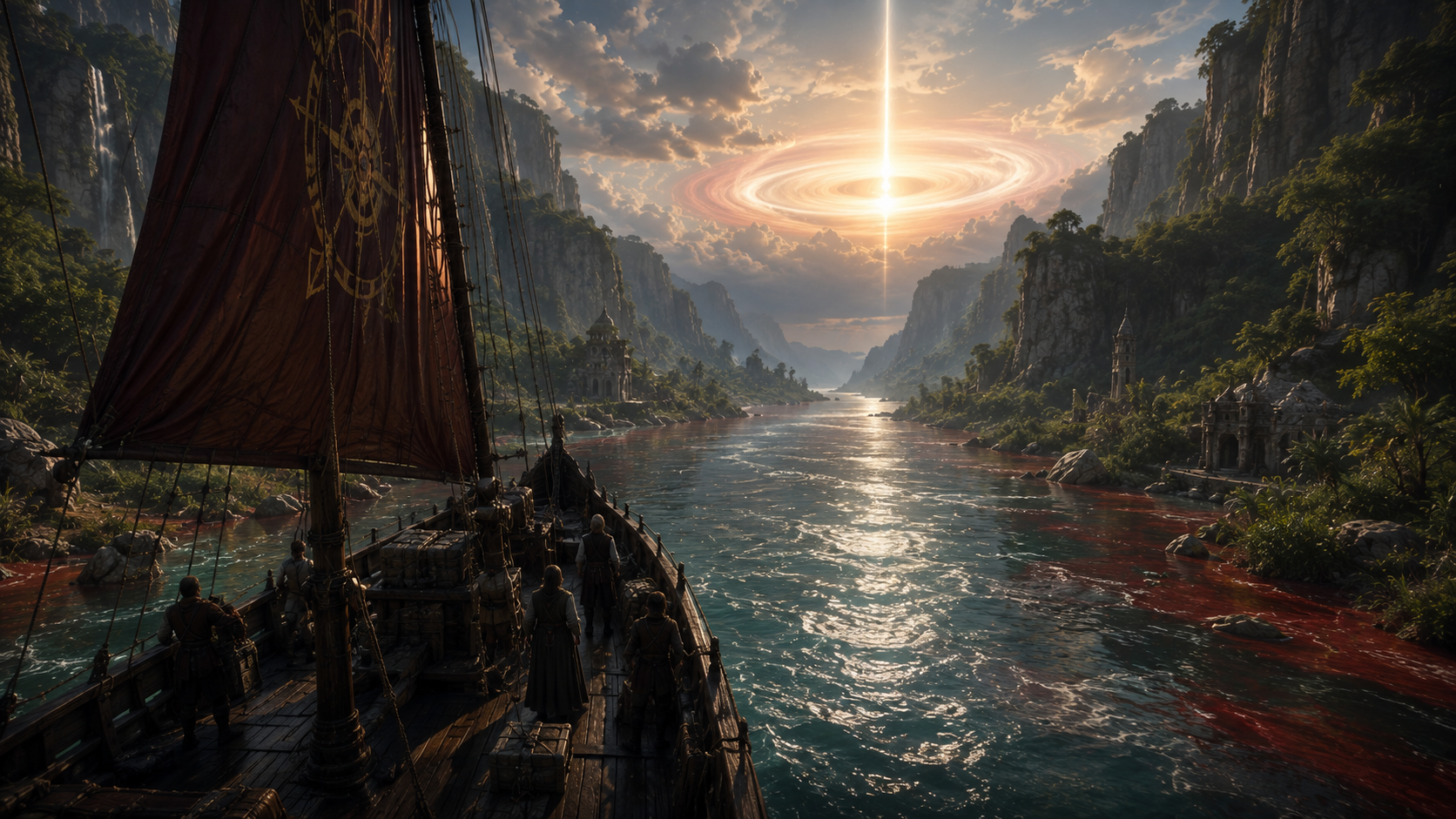
The Godscar is a major geological and religious feature of Arkhaven. It is the great fracture that runs down the continent's vertical centre, forming a chain of vast vertical crevasses, fjords, lakes, drowned valleys, and connected waterways.
The Godscar is not a single canyon or river. It is a linked system of water-filled fractures running through different landscapes, including plains, forests, mountains, lowlands, and coastal regions. Its shape, depth, width, elevation, and appearance vary considerably along its length.
Every known section of the Godscar contains water. In some places it appears as a broad lake or inland channel. In others it narrows into a steep-sided waterway between cliffs. Near the coast, sections widen into fjords and drowned valleys where seawater reaches far inland.
The Godscar predates all currently documented peoples of Arkhaven. Its formation occurred long before the present political systems, religious institutions, borders, and recorded cultures came into being. Those later systems were not broken by the Godscar. They formed around it.
Overview
The Godscar is one of the defining physical features of Arkhaven. It affects travel, settlement, trade, religion, politics, and regional identity because much of the continent has developed around its waters, crossings, cliffs, harbours, and associated sacred sites.
Most religious, historical, and geological traditions agree that the formation of the scar was catastrophic in scale, but no current people of Arkhaven preserves direct knowledge of the event itself.
The event permanently shaped:
- Rivers
- Lake systems
- Mountain edges
- Coastal inlets
- Settlement patterns
- Crossing points
- Trade corridors
- Religious interpretation
In lowland areas, the Godscar often appears as a chain of deep lakes, flooded cuts, and steep-sided waterways. In higher terrain, it becomes a more dramatic rift of exposed stone, cliffs, mist, and waterfalls. Near the coast, sections of the scar broaden into fjords and drowned valleys where tidal water moves inland.
Because of its scale and position, the Godscar forms both a barrier and a route between regions. Safe crossings, ferries, ports, cliffside approaches, and navigable stretches are strategically important and often become centres of settlement, trade, taxation, defence, or religious activity.
Geography
The Godscar varies significantly depending on local terrain.
Common features include:
- Deep vertical crevasses filled with water
- Sheer cliffs and steep escarpments
- Chains of lakes
- Drowned valleys
- Fjords and inland saltwater channels
- Waterfalls and river mouths
- Narrow crossings and natural chokepoints
- Cliffside settlements
- Flooded caverns
- Submerged ruins and structures
- Shallow shelves and deeper channels
The scar is not uniform. Some sections are broad, calm, and navigable, while others are narrow, deep, cold, fast-moving, or partly hidden beneath forest canopies and mist. In several places, rivers flow into the Godscar and form lakes, cataracts, or branching waterways. The severity of the cliffs on either side changes from region to region, with subtle elevation shifts in some areas and dramatic drops in others.
Veinstone Deposits
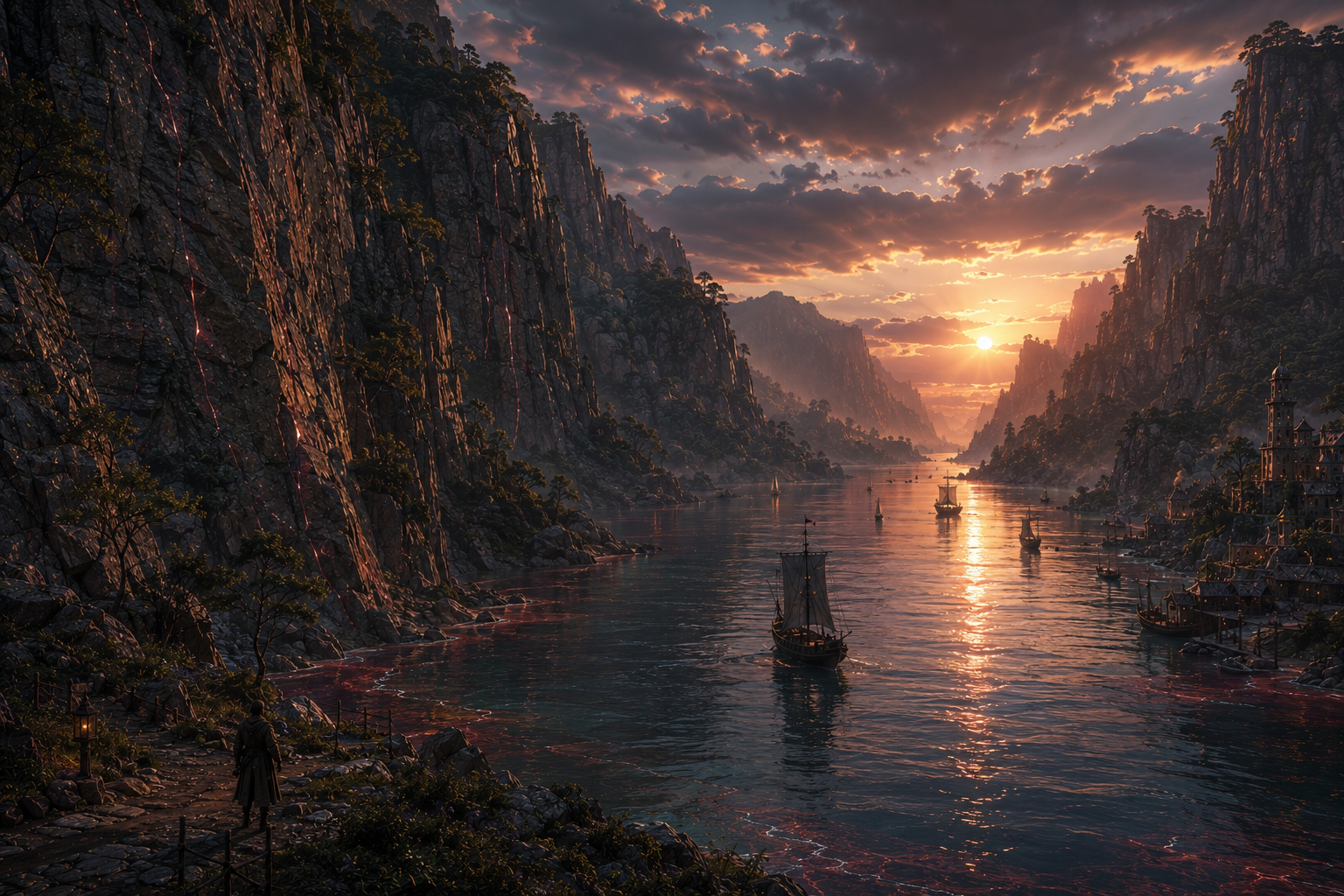
The Godscar contains the largest known concentrations of Veinstone in Arkhaven, or what is left of it.
Veinstone found near the Godscar is typically red, with golden flecks visible through the stone under direct light. Exposed deposits can be found in cliff faces, riverbeds, lower rock formations, and areas where the fractured land has revealed older mineral seams.
The presence of Veinstone has contributed significantly to mining interest, religious attention, institutional study, and political conflict surrounding the scar.
The Red Lakes
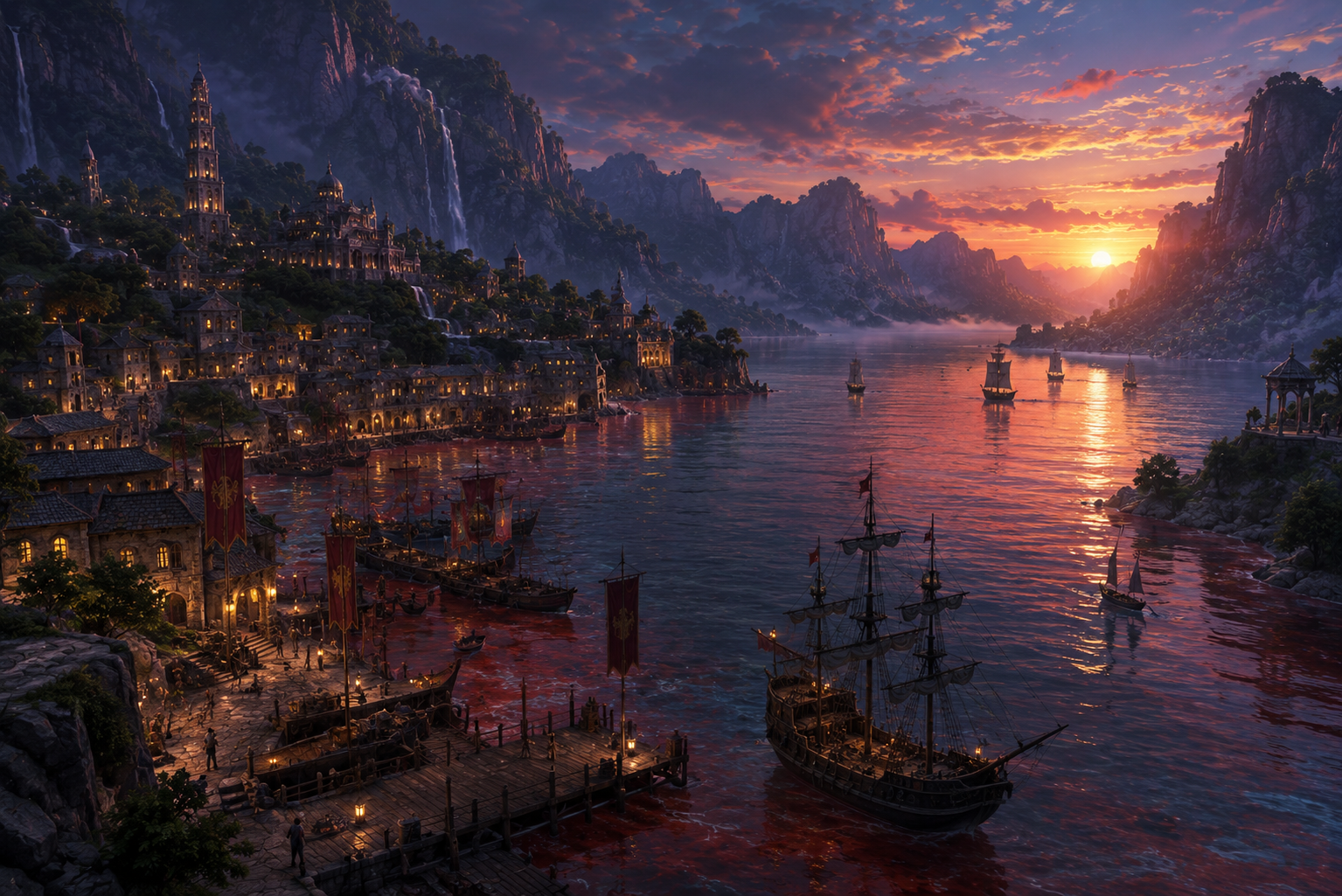
Several lakes and waterways connected to the Godscar display unusual red coloration.
This effect is widely believed to be associated with Veinstone-rich regions beneath or surrounding the water.
The colour varies between locations and environmental conditions. In some places the water appears faintly rust-stained. In others, it can look deep red under still light, especially near shorelines, submerged stone, or areas where mineral deposits are known or suspected.
Consumption of water taken directly from heavily affected lakes is generally discouraged.
Historical reports describe:
- Hallucinations
- Violent dreams
- Behavioural instability
The exact cause of these effects remains uncertain.
Settlement and Travel
The Godscar has a major influence on settlement patterns throughout Arkhaven.
Communities are often established near reliable crossings, navigable waters, defensive cliffs, fertile river valleys, fishing grounds, protected inlets, or religiously significant overlooks. These locations can become economically important because they control movement between regions and access to the waterways of the scar.
Settlements near the Godscar may serve several functions:
- Ferry crossings
- Bridge towns
- Pilgrimage stops
- Fishing communities
- Trade ports
- Watch posts
- Religious sites
- Mining or quarry settlements
- Centres for scholars, relic-hunters, or explorers
Travel across the Godscar is usually limited to known bridges, ferries, causeways, cliffside approaches, or narrow points where the water can be crossed safely. Travel along the Godscar may also be possible by boat, depending on local depth, current, weather, and political control.
Political Importance
The Godscar acts as both a barrier and a route.
As a barrier, it limits movement, slows armies, separates regions, and creates defensible boundaries. As a route, its waterways, fjords, and lake systems can support trade, transport, fishing, and communication.
The Godscar did not alter the borders of the current states by suddenly breaking them apart. It is far older than those states. Instead, political borders, claims, trade systems, and military priorities developed around the geography of the scar.
This makes the Godscar politically important. Rulers may seek to control crossings, ports, ferry rights, cliffside approaches, religious sites, or access to Veinstone-rich regions along its edge. Disputes over these points can become long-running sources of tension between neighbouring realms.
The Godscar also affects regional identity. Communities on opposite sides may develop separate customs, dialects, laws, or religious practices, even when they are geographically close.
Religious Significance
The Godscar is widely regarded as a sacred or spiritually significant place.
Most religions in Arkhaven have some interpretation of the Godscar, but those interpretations developed long after the event itself. The scar was not created within the memory of current churches, kingdoms, or recorded peoples. Instead, later faiths, doctrines, and local traditions formed around attempts to explain its existence.
Religious activity near the Godscar may include:
- Shrines and temples
- Pilgrimage routes
- Ritual overlooks
- Relic sites
- Monastic communities
Not all faiths treat the Godscar as holy in a positive sense. Some consider it dangerous, corrupted, or spiritually unstable.
Relationship to The Scriptor Compact
The Scriptor Compact is closely connected to the study and interpretation of the Godscar.
Because the Godscar is central to many religious traditions, it is a frequent subject of doctrinal dispute. Churches may claim that the scar supports their theology, reinforces their authority, or validates their sacred history.
Scriptors are often required to examine these claims by comparing texts, reviewing older records, identifying later additions, and distinguishing between religious tradition, political propaganda, and possible historical evidence.
An Inquisitor-Scriptor may become involved when claims about the Godscar are linked to heresy, false prophecy, forged relics, cult activity, or disputed miracles.
Relationship to War of the False Saints
The War of the False Saints had a major effect on how religious authorities treat claims associated with the Godscar.
During that period, false prophets and manufactured saints repeatedly used the Godscar as a source of legitimacy. Some claimed visions connected to the scar. Others presented relics, staged miracles, or announced prophecies concerning its origin or future.
As a result, modern churches are cautious about new miracles, relics, or revelations associated with the Godscar. Such claims are usually subject to investigation, especially if they attract followers, challenge existing doctrine, or threaten public order.
Current Status
Most regions along the Godscar are settled, travelled, and economically important. Others remain dangerous, isolated, or poorly documented.
Several sections are likely to contain ruins, abandoned crossings, lost shrines, drowned structures, or settlements not yet formally recorded in the wider histories of Arkhaven.
Continued discovery of Veinstone deposits and ancient structures within the scar has increased institutional interest in the region.
Further detail on specific peoples, settlements, crossings, shrines, ruins, and political territories along the Godscar can be added as the region is developed.
🡐 Arkhaven Lore