The Green Silence
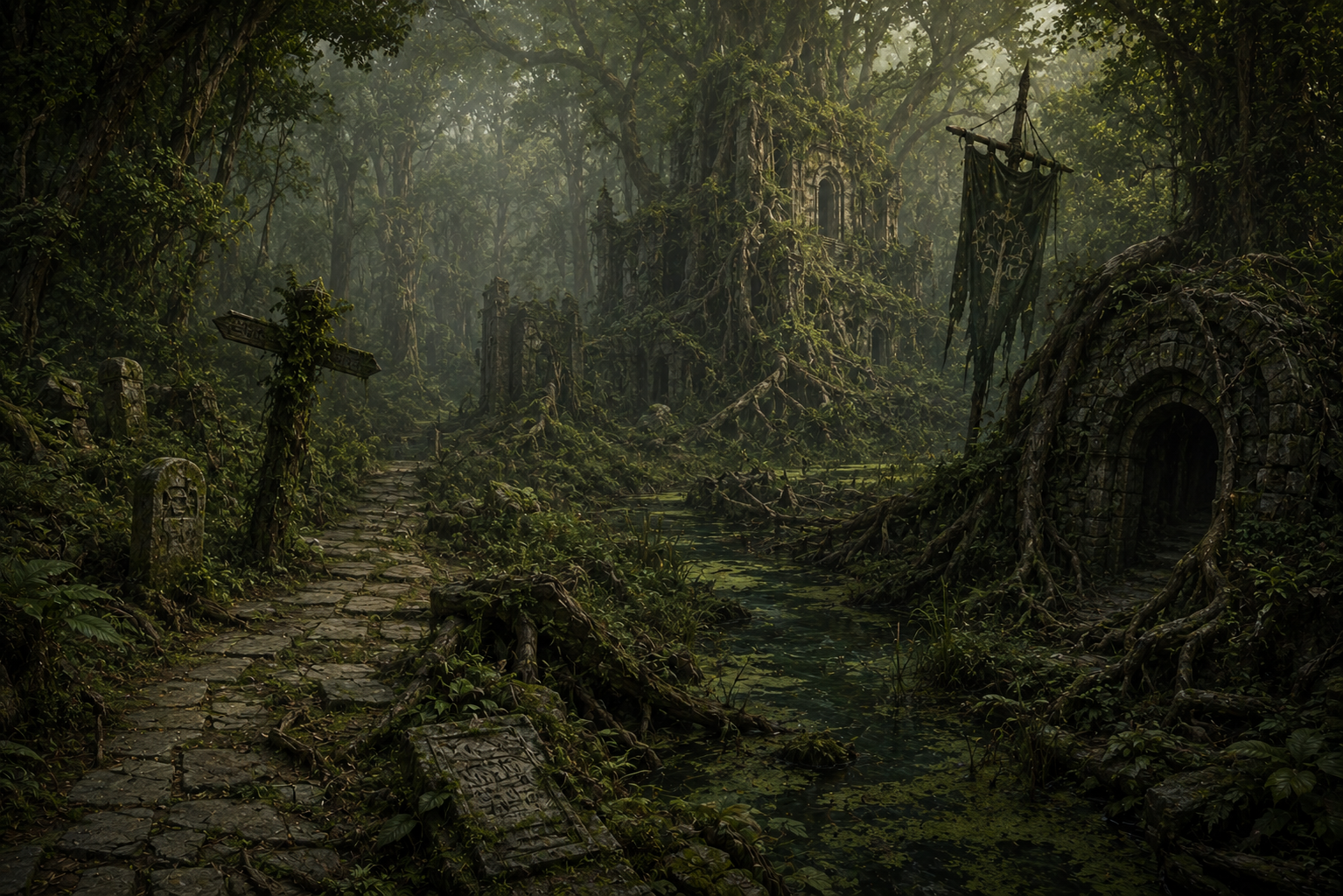
The Green Silence is the name given to the supernatural disaster that transformed the south-western forests of Arkhaven. It occurred after the Elves had already made their home in the region now known as The Silent Weald, but before the modern GS calendar began.
At some point before 1 GS, the forests came alive. Trees, roots, moss, vines, and older powers within the land swallowed roads, towns, shrines, archive houses, towers, and entire stretches of elven civilisation. Many communities vanished. Many records were lost. Much of what the elves had built or preserved before the disaster disappeared beneath the living forest.
The exact cause of the Green Silence is unknown. No church, ruler, scholar, Scriptor, or surviving elven archive holds an accepted explanation. It was not a conventional war, plague, fire, invasion, or natural overgrowth. It is generally understood as a supernatural event whose cause remains unresolved.
The first recorded year of the Green Silence is recognised as 1 GS, forming the basis of the modern Calendar System used across Arkhaven.
Overview
The Green Silence affected the south-western forests of Arkhaven, especially the region now called The Silent Weald. This region is associated with the present-day elven and elven-linked realms of The Martarië Crown, Tirith I Daur, Houses of Bârathanaear, and the southern lands of the Court of Thalóriel. The Verdant Confederacy lies along the more open northern edge of this wider forested region.
The event is most commonly associated with:
- The loss of elven towns, roads, shrines, and archive sites
- The concealment of ruins beneath living forest
- The disappearance of written and oral records
- The isolation of the south-western forest region
- The later rise of elven record-keeping and archive culture
The Green Silence remains one of the defining reasons elves are such diligent record keepers. To many elven scholars, scribes, and Scriptors, history is not merely knowledge. It is something that can be physically lost, buried, swallowed, or erased if it is not constantly preserved.
Name
The term Green Silence has two meanings.
The first refers to the event itself: an unnatural quiet said to have fallen over the affected forest as settlements disappeared, roads vanished, and ordinary signs of civilisation stopped.
The second refers to the loss of history. Names, records, witnesses, lineages, maps, and local traditions were broken or concealed. In this sense, the “silence” is the absence left behind where memory should have survived.
The Forest After The Green Silence
The Silent Weald is not dead, empty, or abandoned. Around twelve centuries after the disaster, the elves have reclaimed much of the forested region and rebuilt many of their towns, cities, archive houses, roads, and sacred sites.
The reclaimed settlements are not simple restorations of what came before. Many were rebuilt around living trees, buried ruins, old root systems, and surviving fragments of pre-Silence stonework. Some places were deliberately left untouched, either out of reverence, fear, uncertainty, or law.
A sense of magic still hangs in the air throughout parts of the Silent Weald. Travellers describe unusual stillness, old roads that do not appear on modern maps, ruins half-held within trees, and groves where sound, light, or memory seem subtly wrong. These effects are recognised, but not fully understood.
Relationship to the Elves
The Green Silence is central to elven history in Arkhaven.
Before the disaster, the elves had already established cultures, settlements, sacred places, and archives across the south-western forests. The Green Silence consumed many of these places and broke large portions of elven historical continuity.
Modern elven states in and around the Silent Weald see themselves as survivors and reclaimers. The Martarië Crown treats itself as the symbolic heart of elven continuity after the disaster. Tirith I Daur guards the forest and its older laws. The Court of Thalóriel preserves records, trains Scriptors, and teaches that the past must be learned to prevent its return.
This history explains the severity of elven record-keeping. Documents are copied, witnessed, translated, sealed, and stored in separate archives because the elves remember that an entire civilisation can lose itself if its records fail.
Relationship to The Scriptor Compact
The Scriptor Compact draws part of its authority from the lessons of the Green Silence.
The disaster showed that records, settlements, roads, and even whole cultural histories can vanish. Long-lived witnesses and protected archives became politically and religiously valuable because they offered some defence against future loss.
Supporters of the Compact argue that elven Scriptors preserve truths that would otherwise disappear. Critics argue that the same elves may control access to histories that should belong to all peoples of Arkhaven.
Relationship to The Godscar
The Godscar and the Green Silence are often compared in scholarship and religious commentary.
The Godscar is usually understood as an event of rupture, exposure, and division. The Green Silence is usually understood as an event of concealment, overgrowth, and disappearance.
The Godscar is far older and predates the currently documented peoples of Arkhaven. The Green Silence belongs to the later recorded history of the continent and forms the basis of the modern GS dating system.
No accepted connection between the two events exists.
Relationship to War of the False Saints
During the War of the False Saints, the Green Silence became a source of religious claims, forged relics, and disputed visions.
False prophets and disputed saints claimed authority from the forest, from ruins supposedly swallowed by it, or from relics allegedly recovered from hidden sites. The lack of reliable public records made these claims difficult to disprove.
Claims connected to the Green Silence remain sensitive, especially when they involve miracles, lost saints, sealed archives, or pre-Compact religious traditions.
Cultural Impact
The Green Silence has influenced language, folklore, and cultural attitudes toward memory in Arkhaven.
Common expressions include:
- A secret being described as having “gone green”
- A family “keeping forest silence” over an old shame
- An abandoned road said to be “waiting for roots”
- A missing witness described as having “walked into the green”
These phrases show how the event became associated with disappearance, concealment, secrecy, and the loss of reliable memory.
Current Status
The Green Silence remains unresolved as a historical and supernatural event.
The Silent Weald is inhabited, defended, and partly reclaimed, but it is not fully understood. Its forests still contain ruins, sealed archives, disputed religious sites, restricted groves, and places where the old magic of the disaster seems to linger.
Further detail on named settlements, elven houses, forest cultures, ruins, roads, and religious sites can be added as the region is developed.
🡐 Arkhaven Lore