Myruun Clans
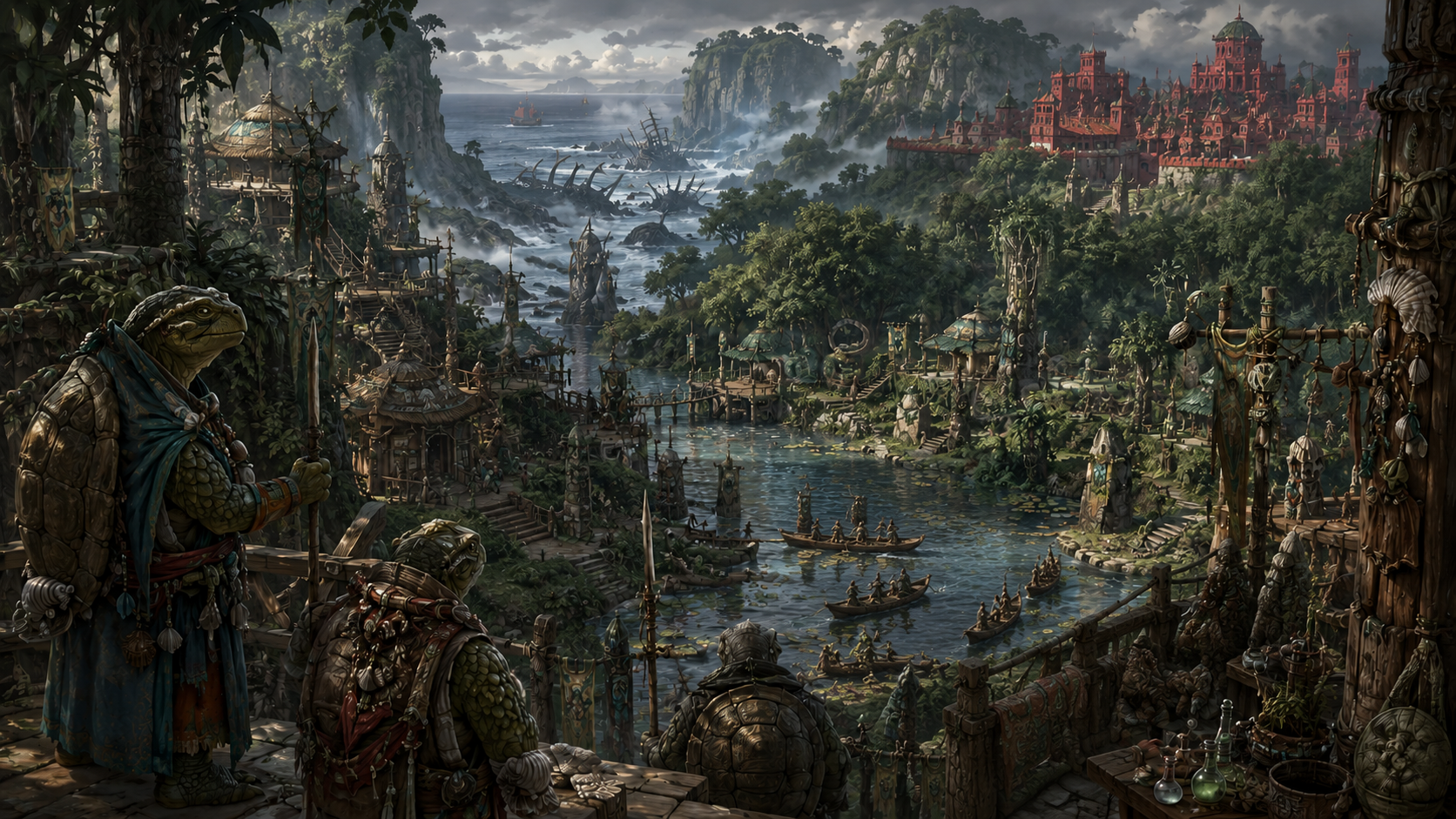
The Myruun Clans are a jungle-based clan society at the top of the middle section of the Crimson Chain.
Their territory is bordered by the Godscar on both sides, the northern sea above them, and The Vermillion Crown to the south.
The Myruun are known for tortle-led clan houses, forest gnome craft, scar-adjacent navigation, coastal shrines, and a stable formal relationship with the Vermillion Crown.
Their position makes them a bridge between jungle, sea, scarred waters, and southern human power.
Government
The Myruun Clans are governed by the Rootbound Pact, a formal agreement between the major clan houses, shrine-keepers, river elders, warrior circles, and coastal speakers.
The Rootbound Pact does not create a single monarchy.
Each clan house governs its own groves, fishing grounds, river mouths, shrines, settlements, and ruin-sites.
Shared decisions are handled through the Rootbound Conclave, where clan leaders settle disputes, renew obligations, arrange trade terms, confirm marriages between houses, divide fishing rights, and uphold foreign agreements.
The most important foreign agreement is the Red Treaty, a formal pact between the Myruun Clans and the Vermillion Crown.
This treaty defines border conduct, trade rights, military passage limits, tribute obligations, and the handling of fugitives, smugglers, pirates, and Godscar relics.
Dominant Peoples
The Myruun Clans are dominated by tortles.
Their coastal settlements, river shrines, shell-marked houses, fishing grounds, and elder councils form the core of Myruun society.
Tortles are the leading people of the Myruun because the region is shaped by jungle rivers, mangrove belts, sea cliffs, flooded lowlands, and scar-adjacent waters.
Their long lives, patience, coastal skill, river knowledge, and defensive settlement habits make them well suited to the territory.
Forest gnomes are the second major people of the Myruun Clans.
They live in root-villages, hidden jungle workshops, elevated burrows, mushroom groves, and shrine-adjacent settlements.
Their illusion magic, herbalism, concealed architecture, trapcraft, mapping, and small-scale invention are essential to Myruun survival.
The Myruun also include lizardfolk, grung, yuan-ti purebloods, kenku, shifters, aarakocra, half-elves, coastal humans, tieflings, and small numbers of Tabaxi.
Tabaxi exist in Myruun territory, but they are a minor population and do not define the clans.
Region and Biome
The Myruun Clans occupy the northern end of the central Crimson Chain.
The land is narrow, humid, and heavily forested, with the Godscar pressing close on both sides.
The northern coast opens onto the sea, while the southern border meets the Vermillion Crown.
The region consists of dense jungle, coastal cliffs, black-water rivers, mangrove belts, fog-heavy ravines, vine-choked ruins, salt marshes, and elevated settlement mounds.
Inland trails are difficult to maintain because the jungle reclaims cleared paths quickly.
Settlements are built in defensible positions: raised root-platforms, coastal hilltops, cliff terraces, river islands, stilted halls, shell-ringed compounds, and hidden forest gnome burrows.
Clan shrines sit at river forks, old trees, sea caves, stone ruins, and scar-facing cliffs.
The Godscar shapes the region’s geography and politics.
Scarred waters, strange tides, old wrecks, broken coastlines, and unstable passages limit movement, but they also protect the Myruun from large invading armies.
Culture
Myruun culture is clan-based, ritualised, watchful, and diplomatic.
The clans are skilled at surviving between stronger powers without being absorbed by them.
They value oathkeeping, controlled hospitality, scar navigation, jungle medicine, river knowledge, silence in dangerous places, and respect for old boundaries.
Myruun social life is built around clan houses rather than cities.
Each house maintains its own hall, shrine, burial grove, canoe docks, and guarded storehouses.
Tortle elders hold high status because they preserve long memories of treaties, floods, monster migrations, and border disputes.
Forest gnome craft-clans hold major influence because their hidden paths, warning charms, concealed shelters, and disguised storehouses keep the clans safe.
The Myruun are not isolationist.
They trade actively with the Vermillion Crown and coastal merchants.
They provide rare jungle medicines, venom extracts, hardwoods, fish, shell dyes, relic fragments, monster parts, and guides capable of navigating scar-adjacent waters.
Their diplomacy is formal and deliberate.
Guests are welcomed through ritual, watched closely, and judged by their respect for local taboos.
Insults are remembered, but honoured agreements are preserved for generations.
Masks are central to Myruun public ceremonies.
Masks identify clan office, ritual role, treaty status, mourning, or war duty.
Removing another person’s ceremonial mask without permission is a severe offence.
Religion and Magic
The Myruun Clans worship jungle spirits, sea powers, ancestor guardians, river mouths, storm spirits, shell-ancestors, serpent gods, and old entities associated with the Godscar.
Their religion is practical and territorial.
Each shrine protects a place, route, bloodline, or oath.
Magic is common among shrine-keepers, forest gnome illusionists, serpent-priests, tide-readers, shamans, curse-breakers, and scar-diviners.
Myruun magic is used for healing, venom work, warding, weather signs, spirit appeasement, water breathing, masking trails, protecting boats, concealing settlements, and identifying dangerous relics from the Godscar.
The clans treat Godscar relics with strict caution.
Some are traded under the Red Treaty.
Some are sealed in shrine-vaults.
Some are destroyed during moonless rites.
Removing a relic from a protected site without clan permission is a crime against both the clan and the land.
Relationship with the Vermillion Crown
The Myruun Clans have a stable and formal relationship with the Vermillion Crown.
This relationship is based on the Red Treaty, which was signed after early border conflicts proved costly for both sides.
The Vermillion Crown recognises Myruun control over the northern jungle corridor of the Crimson Chain.
The Myruun Clans recognise Vermillion authority south of the agreed border.
This arrangement stabilises the region and prevents constant warfare along the Crown’s northern approach.
Under the Red Treaty, the Myruun provide guides, scouts, medicinal goods, hardwoods, monster knowledge, coastal warnings, and controlled access to scar-adjacent routes.
The Vermillion Crown provides metal tools, weapons, coin, grain, salt, legal recognition, and protection against foreign claimants using Crown lands to threaten Myruun territory.
The treaty also regulates fugitives, smugglers, pirates, and relic hunters.
Vermillion criminals hiding in Myruun land are judged by treaty law.
Myruun offenders fleeing south are returned through formal process.
Godscar relics found near the border are inspected by both Myruun shrine-keepers and Vermillion officials.
The Myruun do not love the Vermillion Crown.
They respect the treaty because it works.
Tensions
The central tension of the Myruun Clans is the Red Treaty itself.
It gives the clans stability, trade, and protection from southern expansion, but it also binds them to the Vermillion Crown’s politics and enemies.
Younger warriors, hardline shrine-keepers, and some forest gnome hidden-houses resent the treaty’s limits, while tortle elders and senior clan houses defend it as the reason Myruun territory remains intact.
🡐 States of Arkhaven