Kharad Wildlands
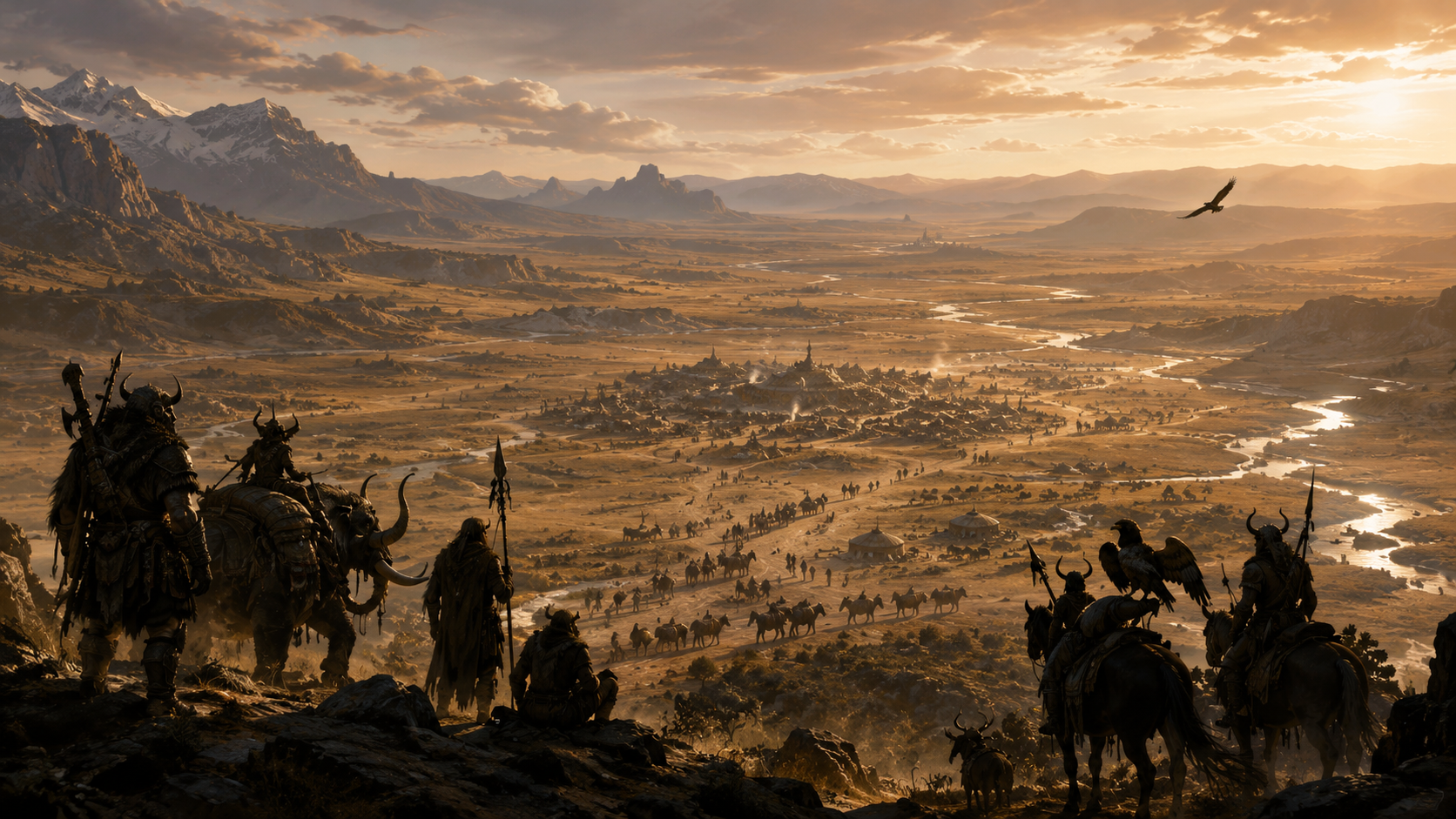
The Kharad Wildlands are a broad, arid frontier of open plains, mountain-fed rivers, and roaming peoples.
They are not a unified kingdom, but a shared homeland and trade region for hardy tribes, travelling clans, and independent settlements that survive through mobility, negotiation, and knowledge of the land.
Government
There is no single ruler of the Kharad Wildlands.
Authority is local and mobile, usually held by tribal chiefs, caravan leaders, elder councils, mountain clan-heads, and respected mediators.
Major decisions are often made through gatherings in the central plains, where different peoples meet to trade, settle disputes, arrange alliances, and respond to outside threats.
Dominant Peoples
The region is home to peoples suited to harsh climates and open wilderness.
Goliaths are common in the colder southern mountains and highlands, though many roam down into the plains.
Loxodon tribes are influential among the warmer lowlands and river routes.
Other possible inhabitants include firbolgs, centaurs, minotaurs, orcs, half-orcs, gnolls, kenku, aarakocra, and nomadic human or halfling groups adapted to dryland life.
Some dwarves also live in the mountains, especially prospectors, miners, and independent clans seeking wealth outside older dwarven realms.
Region and Biome
The Kharad Wildlands sit between several stronger neighbours: elven lands to the west, the Zul’Akari Clans to the north, and human powers to the east and south-east.
The land is mostly arid plain, scrubland, rocky badlands, and dry river country, with rivers flowing down from the southern mountains.
These rivers are vital for travel, grazing, settlement, and trade.
The south is colder and more mountainous, while the central and northern lands are warmer, drier, and more exposed.
Culture
Kharad culture is practical, mobile, and trade-focused.
Most communities value hospitality, oath-making, navigation, animal handling, river knowledge, and survival skills.
Trade gatherings are central to political and social life, bringing together mountain folk, river traders, plains nomads, dwarven prospectors, and foreign merchants.
Wealth is often measured in livestock, water rights, safe routes, metalwork, trade goods, and reliable alliances rather than fixed territory.
Religion and Magic
The peoples of the Kharad Wildlands generally worship their own gods, spirits, ancestors, or natural powers.
Religion varies between tribes and races rather than being organised under one state faith.
Magic exists, but is usually practical. Weather-reading, water-finding, healing, protection, animal handling, stonecraft, and travel magic are especially valued.
Among the dwarves, divine and rune-based traditions may also be common.
Tensions
The main external threat is human expansion from the east and south-east, especially if nearby human states seek farmland, mineral wealth, trade routes, or river control.
The Wildlands also face pressure from their position between stronger settled powers, including the elves to the west and the Zul’Akari Clans to the north.
Internally, disputes can arise over water rights, grazing land, trade access, and mining claims.
The long-term drying of the land is a growing danger, increasing competition over rivers, wells, and fertile ground.
🡐 States of Arkhaven